

How to Involve Attendees at Corporate Events


Every corporate event represents a significant investment. The venues, the speakers, the logistics, all of it justified by one assumption: that attendees will show up, engage, and leave with something valuable.
That assumption doesn’t always hold.
Even well-planned events can fall flat. Sessions that feel one-sided, networking moments that never quite spark, and post-event surveys that reveal attendees felt more like an audience than participants. When that happens, it’s rarely a content problem or a budget problem. It’s an engagement problem.
And engagement, it turns out, is something you can plan for.
The most successful corporate and association events aren’t more engaging because they got lucky with the right crowd. They’re more engaging because the organizers made deliberate choices — about structure, timing, format, and follow-up — that gave attendees every reason to participate.
In this guide, we’ll cover why disengagement happens in the first place, and walk you through eight practical strategies to involve your attendees before, during, and after your event so that participation isn’t left to chance.
Why is engagement important for corporate event success?
A full room may signal strong attendance, but the real business value of your event comes from how well you keep attendees engaged. Here’s why you should involve your attendees at corporate events:
1. Improves knowledge retention
According to a Freeman networking trends report, more than half of attendees expect to leave an event feeling like they learned something. Engagement plays a major role in whether that expectation is met. Without it, high-value sessions turn into passive listening and retention drops.
Using discussion-based formats and audience interactions keeps attendees mentally present and more likely to absorb and remember information. This is especially important for training sessions, sales kickoffs, leadership summits, and association learning programs, where success depends on post-event action.

2. Increases attendee satisfaction
Disengaged attendees may leave unsure whether the event was worth their time. This impression makes them unlikely to attend future events and damages your professional credibility.
Engagement changes that experience. In fact, 78% of event professionals rate content quality as “very important” to event success. Engagement is what determines whether that content actually lands – and whether attendees leave satisfied.
3. Strengthens exhibitor ROI
Disengaged attendees are usually less likely to visit booths, speak with sponsors, or explore exhibitor offers. This translates to fewer meaningful conversations and lower lead quality for exhibitors. Increasing audience interaction heightens their curiosity, guides them toward exhibits, and ultimately supports stronger event ROI.
4. Measurable data and event metrics
Without engagement, it’s difficult to measure impact beyond surface-level metrics. Tracking participation, session activity, and attendee behavior provides a clearer picture of performance. This visibility gives you a better understanding of where your events are already delivering results and what you can refine and improve for future events.
4 Causes of low engagement at corporate events
No event organizer sets out to create a low-engagement experience, yet it still happens more often than expected. As a result, teams plan corporate events that look complete on paper but fail to fully keep attendees involved. Below are four of the biggest drivers of low engagement at corporate events:
1. Passive presentation formats
Our research found that 38.4% of event planners rank attendee engagement as their top operational challenge. And when we dug deeper, a clear pattern emerged: passive formats are a primary culprit. Long keynotes and static panels struggle to hold attention, and true engagement requires effort before, during, and after the event, not just onsite.
Shifting to more participatory formats gives attendees a reason to stay mentally present. Booking.com Business reports that 77% of attendees say interactive elements improve their event experience. From these numbers, it’s clear that contribution and participation are key to keeping attendees consistently engaged.
2. Lack of personalization
Although corporate events usually have a general target audience, the crowd is rarely uniform. Attendees come with their individual goals, roles, preferred learning methods, and expertise levels, and your event should feel relevant to them.
When everyone receives the same content, large parts inevitably feel misaligned or unnecessary, and people pay less attention. Eventually, this disconnect reduces both the perceived value of the event and the likelihood that attendees will stay fully engaged through each session.
3. Weak technology integration
Digital planning tools improve your delivery and pass messaging across more clearly than an overly manual process. Sidelining them for a largely analog experience may leave your audience feeling underwhelmed and uninspired.
However, simply having these digital tools is not enough. Poor integration and fragmented systems create friction that pulls audience focus away from your corporate event. Similarly, unclear or clunky interfaces turn technology into a barrier rather than a support tool. This ultimately undermines the entire experience.
4. Poor real-time responsiveness
Many organizers plan in detail but execute these plans rigidly. This leaves them with little room to adapt if engagement drops mid-session. Disengagement ends up compounding as the event progresses. By the end, some attendees have mentally checked out and they’re leaving without any value added.
When planning events, build in flexibility from the start. A 10-minute buffer each hour, or space for spontaneous Q&A, goes a long way. Timely responsiveness to disengagement is what separates a good event from a great one.
How to involve attendees at corporate events in 8 simple steps
To keep attendees involved at events, you need a deliberate, end-to-end strategy. This strategy should guide their experience and keep them actively engaged at each stage, from pre-event planning to post-event follow-up. Here’s our eight-step process to achieving this:
Step 1: Define clear goals before planning
Before choosing engagement tactics, you must define what success looks like for your organization. This helps you decide who to target, which sessions to prioritize, and which activities to include.
Align engagement with business outcomes. Instead of planning with vague aims like “make it interactive,” define what actions you want attendees to take and how those actions support event success.
Specific actions will vary depending on your event. For a sales kickoff, target product knowledge retention among attendees. A customer conference, on the other hand, may focus on deepening account engagement, while an association event should prioritize driving meaningful member participation.
Some questions to ask when defining engagement goals are:
- What are our organization’s goals for this event?
- How will engagement contribute to overall event ROI or business objectives?
- What specific actions do we want attendees to take during the event?
- How should attendees interact with sessions, speakers, sponsors, or exhibitors?
Well-defined goals shape every planning decision that follows.
Step 2: Gather attendee data early to understand expectations
Understanding your audience’s needs and expectations is key to improving engagement. Relying on assumptions leads to impersonal experiences that fail to connect. This ultimately lowers engagement across the board.
Accurate attendee data helps you truly understand your audience. With it, you can align your goals with attendee expectations. You can then design sessions, formats, and interactions that stay relevant to your audience’s experiences.
Use these tips to gather data before the event:
- Send out timely pre-event surveys asking about attendees’ professional goals, challenges, and reasons for attending
- Segment registration data by job role, department, membership type, industry, seniority, or customer stage
- Review past event data to spot patterns, such as attended sessions or engagement, if this is a recurring event
- Monitor email engagement or clicks and allow preference selection for specific topics or networking interests during registration
- Keep surveys short and focused to increase response rates
A detailed data collection system sets you on track for an intentional, measurable process before the event begins.
Step 3: Personalize agendas
Generic content makes an audience lose interest quickly as it communicates little value to them. It also creates overloaded schedules and long agendas packed with sessions that don’t apply to every attendee.
On a practical level, personalization entails shaping your plans and audience experience around attendee data. It aligns your sessions, networking, and content with what each attendee actually cares about. For example, executives may need strategy-focused sessions, while practitioners may prefer workshops, demos, or peer discussions.
Here are some tips to help you create a more personalised event:
- Segment attendees by role, industry, or seniority
- Offer customizable agendas, track options, and activities instead of fixed plans
- Send targeted reminders for sessions aligned with attendees’ goals
- Create role-specific networking opportunities
- Adjust content depth to match the specific audience
- Use event apps to surface relevant content in real time
When attendees see content that reflects their needs, they’re far more likely to engage, participate, and stay invested throughout the event.
Step 4: Streamline interaction with a centralized platform
When attendees have to jump between emails, documents, and multiple sign-up or registration forms, their engagement drops fast. Additionally, friction in access and navigation frustrates them and makes your organization appear less competent. Together, these factors actively discourage responsiveness.
Many organizers are using event management platforms to solve this. A centralized platform unifies the entire event workflow, simplifying the process of finding information and participation.
When choosing a platform, ask the right questions. Does it display the agenda, speakers, and exhibitors in one clear place? Does it push real-time updates when something changes? Does it support interactive features and messaging without redirecting attendees elsewhere?
Seamless attendee management and check-in tools are also worth considering. Finally, look for integrated analytics and reporting so you have the insights needed to improve future events.
Beyond features, look for platforms that reduce complexity. Disconnected systems create data silos and attendee disengagement, while integrated solutions ensure accuracy and consistency across the entire event lifecycle.
Pro tip: One common challenge is delivering the same level of engagement to both physical and remote audiences with ease. EventsAir offers an interactive, in-person, 3D virtual, and hybrid event experience in a single, integrated platform rather than multiple disconnected tools.
Step 5: Design interactive sessions
Attention in corporate settings can be short, especially when people sit through sessions for long stretches. Even in well-run events, focus tends to drift quickly if nothing pulls it back or sustains momentum.
To maintain this focus, bring your attendees into the discussion and encourage participation. Inviting them to contribute directly resets their attention, improving retention and overall experience.
Practical interactive event ideas include:
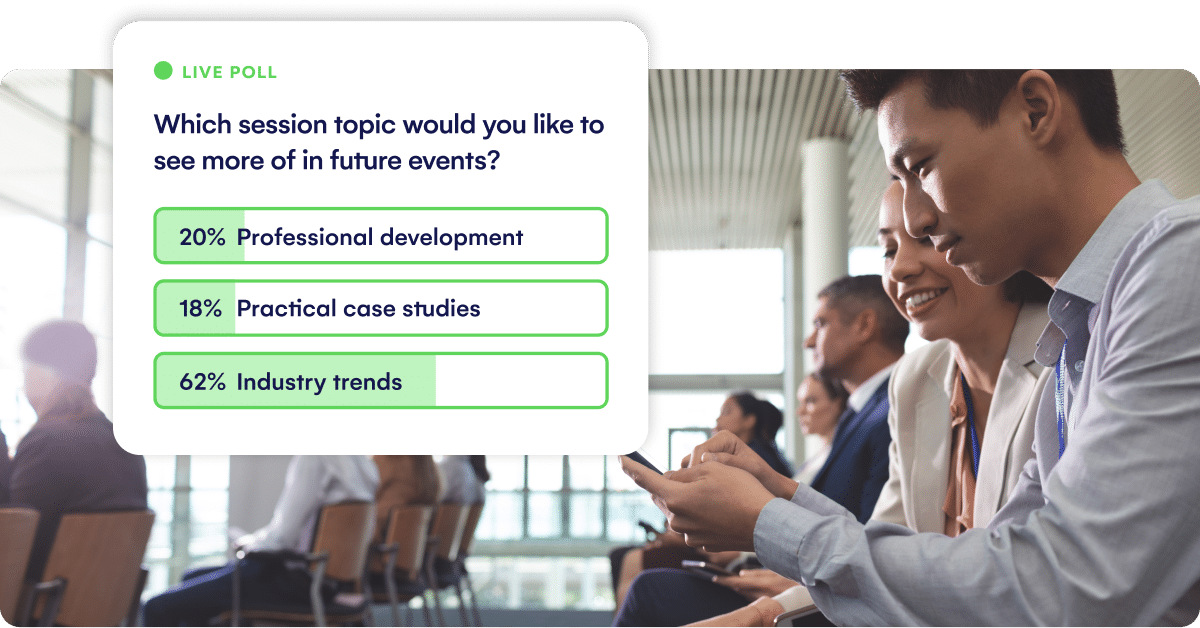
- Live polls and real-time Q&As: Instead of saving questions for the end, integrate polls during leadership summits, town halls, or customer conferences every 10–15 minutes to keep attention high.
- Interactive quizzes: Short quizzes, case challenges, or scenario-based tasks can tap into competition. They can also be used to reinforce learning in sales kickoffs, training sessions, or certification workshops.
- Breakout segments: Occasionally, break the audience into smaller discussion groups or round tables. These formats work especially well for association meetings, customer advisory boards, or internal strategy sessions where peer discussion matters.
- Hands-on workshops: Workshops allow attendees to apply ideas in real time, making them especially effective for technical training, product education, or professional development sessions.
Step 6: Incorporate structured networking
For many attendees, networking is the primary reason they show up. Yet they consistently leave without meaningful connections. This is largely because networking is left unguided, pushing attendees to stick to familiar faces or avoid interaction entirely.
To change this dynamic, networking must be embedded into the agenda at structured, carved-out moments. Curated sessions, round tables, buyer-supplier meetings, and facilitated discussion groups give attendees the structure they need to connect meaningfully.
Apply the same thinking to exhibitions. Attendees shouldn’t have to figure out where to go or who to approach. Gamifying booth visits, for example, turns passive wandering into active exploration. Including sponsor showcases or exhibitor demos in the agenda also gives attendees clear reasons to engage. Finally, linking sessions to sponsors creates a seamless connection between content and exhibition.
When networking is structured rather than assumed, attendees can focus on making the connections they came for.
Step 7: Monitor engagement metrics and analytics
Despite engagement being one of the most cited challenges in the industry, many event professionals still lack a consistent method for measuring it. Tracking the right metrics before, during, and after the event gives you a continuous feedback loop. Engagement metrics also help prove value to executives, board members and other internal stakeholders.
Not all metrics, however, are worth your attention. A focused set of event KPIs tells you more than a sprawling dashboard ever could. The five metrics below are the most important ones to track:
1. Registration conversion rate
This metric measures how many people who show interest actually complete sign-up for the event. Low figures usually signal unclear value or friction in registration, so simplifying the process and sharpening event messaging helps pull more attendees in and sets the stage for engagement early.
2. Attendance rate
The attendance rate shows how many registered attendees actually show up on the event day. Declining rates often mean weak pre-event engagement or poor reminders. To correct that, use stronger pre-event communication and clear value reinforcement to help ensure people actually participate.
3. Session attendance rate
This tracks how many attendees join and stay in individual sessions. When numbers are low, it usually signals a content mismatch with the audience or weak session design. Make sessions more interactive, shorter, and more topic-focused to capture and hold attention.
4. Event app adoption rate
Your app should have high activity as the center of your total event lifecycle, so low adoption equals missed opportunities and low interaction. This could either be due to friction in use or misinformation. First, get a centralized, seamless platform, then clearly communicate its benefits to attendees to get them involved.
5. Engagement score
This gives you a view of your audience’s engagement in real time. A low score may signal passive behavior or declining interest. Increasing interactive touchpoints like polls, networking, and live participation helps bring energy back into the experience.
Step 8: Follow up after the event
Without a clear follow-up strategy, you’re likely to lose valuable momentum, and connections will fade quickly. Post-event engagement keeps attendees in the loop, reinforces key insights, and channels short-term participation into long-term value. It also sets your company apart as one that cares in depth about attendees’ gained value.
Here’s how to drive post-event engagement:
- Send personalized follow-up emails based on sessions attended
- Share on-demand recordings and key session takeaways
- Distribute targeted post-event surveys to capture actionable feedback
- Facilitate continued networking through dedicated communities or groups
- Use engagement data to segment sales follow-up, member nurture, sponsor reporting, or invitations to future events
When done well, post-event engagement can transform a one-time corporate event into an ongoing experience that continues to deliver value for both the organizers and attendees.
Drive attendee engagement with EventsAir’s interactive tools

EventsAir is an all-in-one event management platform built for in-person, virtual, and hybrid events of any size. From pre-event planning to post-event reporting, EventsAir keeps everything connected, eliminating the need for multiple tools.
EventsAir has earned the trust of industry leaders worldwide by consistently delivering engaging, standout corporate and association events. Here’s why teams trust us to get things right:
- Real-time analytics and reporting: EventsAir surfaces live engagement data through dashboards during the event itself. You can, consequently, identify drop-off points and respond before they compound.
- True hybrid event capability: Remote and in-person attendees often have very different engagement experiences. EventsAir unifies both formats so every attendee stays equally involved, regardless of where they are.
- Built-in attendee engagement tools: Live polling, Q&A, and gamification are built directly into the platform. These give attendees active ways to participate, rather than sitting passively through sessions.
- Self-service attendee experience: Mobile apps and self-check-in kiosks remove friction from the moment attendees arrive. When navigation feels effortless, attendees focus their energy on engaging with the event itself.
- Structured networking and exhibitor engagement: EventsAir integrates exhibitor interactions and networking opportunities directly into the event flow. Attendees, therefore, have guided reasons to connect rather than being left to figure it out themselves.
- Complete event lifecycle management: EventsAir connects planning, delivery, engagement, and reporting in one unified platform. This gives your team more time to focus on the event, rather than switching between tools.
Final note: Stop losing attendees to disengagement
Corporate events that fail to engage can waste budget, weaken trust, and reduce ROI. Good planning only goes so far. Without tools that support interaction and track behavior in real time, disengagement is difficult to catch and harder to fix.
EventsAir gives you everything you need in one place. The platform features built-in engagement tools, real-time analytics, and a branded event app to keep attendees involved throughout the event.
Ready to stop guessing and start delivering? Book a demo and boost attendee engagement with EventsAir’s interactive tools, mobile app, and real-time analytics.
See EventsAir in action
Discover why 12,000+ event professionals trust EventsAir to deliver effortless events, every time.



Ready to transform event chaos into clarity?
With EventsAir, you’ll move from chasing logistics to creating unforgettable moments. Plan faster, act with confidence, and deliver exceptional events. Discover what’s possible with a personalized demo today.