

Top 12 Event Industry Insights & Trends for 2026


At their core, events bring people together in ways no other medium can. They build trust, create shared experiences, and offer unmatched opportunities for engagement.
Our newly released industry report, The State of Events 2026, brings together insights from over 380 event professionals across APAC, EMEA, North America, and beyond. With honest reflections on the current climate and forward-looking strategies for the year ahead, it offers a grounded yet optimistic lens on the future of event planning.
If you're an event planner looking to stay ahead of the curve, here are the top 10 trends and insights shaping the events industry in 2026:
- In-person remains the most valuable event format
- Budget pressure is reshaping event formats and priorities
- Planners are prioritizing scalable, integrated event tech
- Content quality is the #1indicator for attendee satisfaction
- Planners are focusing on smaller, more impactful experiences
- Nearly 40% of planners say engagement is still a top challenge
- Success is being redefined beyond attendance
- AI is gaining traction across the events industry
- Connected data is the backbone of scalable events
- Hybrid and virtual events are evolving, not disappearing
- Planners are taking on more strategic, insight-led responsibilities

1. In-person remains the most valuable event format
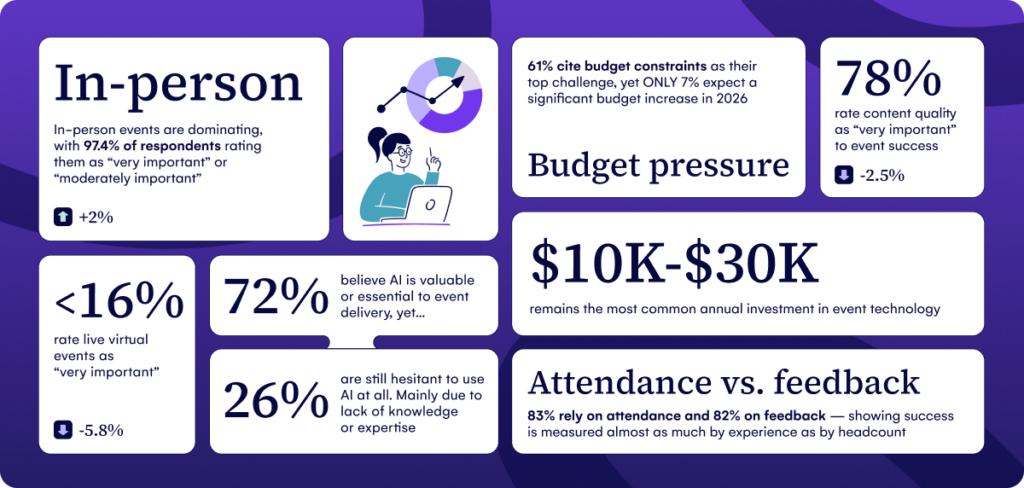
In-person events have reclaimed their central role in the event strategy mix. In 2026, a striking 97.4% of event professionals rated in-person events as either “very important” or “moderately important” to their strategy – up from 95.4% in 2025.
Face-to-face gatherings continue to deliver irreplaceable value: richer networking, stronger engagement, and tangible ROI. The demand for physical connection has not just returned, it’s intensified, driving renewed investment in high-quality, premium-style in-person experiences.
At the same time, planners are approaching formats more intentionally. While hybrid and virtual events still have a place, they’re now deployed strategically to expand reach, extend content life, or accommodate accessibility.
"We had clients that were virtual-only for a while, then hybrid. But now we’re seeing a strong return to fully in-person events. That personal connection is back in demand. People want to be in the room – engaging, networking, experiencing the event together." — Ryan Mindling, Co-Founder, Navis Events

2. Budget pressure is reshaping event formats and priorities
Financial pressure continues to shape every aspect of event planning in 2026. This year, 61.9% of event professionals named budget constraints as one of their top challenges – a figure nearly unchanged from 2025, reflecting the persistent tension between rising costs and flat funding.
Despite high demand for in-person events, the majority of planners are operating with little to no budget growth. Only 7% expect a significant increase in funding this year, while nearly 60% anticipate flat or reduced budgets.
This reality is driving a shift in mindset. Instead of scaling back, planners are becoming more selective by prioritizing fewer, high-impact experiences that clearly justify spend.
Event technology is playing a crucial role here. Not as an added cost, but as an enabler. With the right platform, planners are scaling efficiently, tracking ROI in real time, and uncovering new ways to streamline delivery.
More planners are also turning to monetization strategies, such as premium content access or data-driven sponsorship upgrades, to offset costs and expand revenue potential. The key is choosing technology that not only reduces overhead, but scales with demand and unlocks new value as expectations continue to rise.
3. Planners are prioritizing scalable, integrated event tech
Event technology remains foundational, but the conversation has evolved. In 2026, it’s not just about having digital tools, but about ensuring those tools are integrated, scalable, and aligned with strategic goals.
A large majority of planners continue to invest in technology, with $10K–$30K still the most common annual spend. But increasingly, professionals are choosing platforms that reduce friction, integrate across workflows, and enable real-time insight into performance.
Disconnected systems and point solutions are losing favor. Instead, planners are looking for platforms that support everything from registration and engagement to reporting and budget management. This ensures planners can personalize experiences, automate tasks, and demonstrate event ROI without added complexity.
"Many associations are still using makeshift systems instead of centralized CRMs. It's not sustainable. They're realizing that without proper data infrastructure, they can't deliver the experience modern attendees expect." — Barbara Löffler, Mondial Congress & Events

4. Content quality is the #1 factor in attendee satisfaction
In 2026, content remains king. According to this year’s report, 78% of event professionals rate content quality as “very important” to the success of their events. This makes content quality the top driver of attendee satisfaction and overall event performance for the second year in a row.
What defines strong content today? It’s not just about informative sessions, it’s about narrative flow, speaker confidence, and session formats that invite engagement. From live Q&As to peer-led discussions, planners are focusing on well-curated programs with fewer but higher-value sessions, engaging speakers, and formats that encourage participation.
There’s also a renewed emphasis on intentional programming. Attendees are drawn to content that feels curated for them – based on roles, interests, or challenges – rather than one-size-fits-all delivery. The trend toward personalization extends to how sessions are promoted and followed up post-event.
5. Planners are focusing on smaller, more impactful experiences
In 2026, many planners are trading scale for substance. Rather than chasing ever-larger audiences, they’re focusing on smaller, more curated experiences that deliver outsized value.
With limited budgets and rising expectations, there’s a clear shift toward formats that prioritize intimacy, exclusivity, and high engagement. Think sold-out retreats, invite-only roundtables, or conference tracks tailored to specific roles or sectors.
This isn’t about doing less. It’s about doing what matters and doing it well. When events are designed for a clearly defined audience, the result is often deeper engagement, stronger outcomes, and a more memorable overall experience.
Real value doesn’t always come from volume. Increasingly, it comes from relevance.
“The most expensive event we’ve ever run was a cruise incentive in Japan, and it sold out in two months. I think that shows when people see a unique, high-quality experience, they’re willing to invest in it. There’s still strong appetite for in-person, premium-style events.” — Mike Tuzee, Founder & Managing Director, Impact Events
6. Nearly 40% of planners say engagement is still a top challenge
Engagement continues to be one of the most critical – and elusive – aspects of event success. In 2026, 74% of event professionals identify engagement as a key success factor, yet 39% still cite it as one of their top challenges.
This gap signals a fundamental shift: passive formats are losing traction. Long keynotes and static panels struggle to hold attention. Attendees now expect dynamic, personalized experiences that invite interaction across multiple touchpoints.
To meet these expectations, planners are turning to:
- Curated networking, like hosted roundtables and peer groups
- Multi-modal engagement, from live polling and wellness spaces to podcast booths
- Gamification, Q&A tools, and real-time feedback loops built into mobile event apps
The goal? Designing experiences that feel relevant and rewarding, even for attendees who may not visibly engage.

7. Success is being redefined beyond attendance
In 2026, event success is no longer measured by headcount alone. While 83% of professionals still use attendance as a core metric, an almost equal number – 82% – now prioritize attendee feedback as an equally critical measure of success.
This near-parity reflects a deeper shift: event ROI is being judged not just by who shows up, but by what they experienced, how they engaged, and whether they return.
Planners are now assessing success across a mix of qualitative and quantitative metrics, including:
- Engagement depth (e.g. session interactivity, networking activity)
- Feedback sentiment (what resonated vs. what missed the mark)
- Post-event impact, such as renewed sponsorships, repeat attendance, or long-tail content engagement
This broader view is also helping event teams communicate value more effectively to sponsors and stakeholders, who increasingly expect insight into outcomes
“Success is no longer defined purely by how many people walked through the door. It’s about who was in the room, how they engaged, and what happens after the event ends.” — Rosie Peace, Public Relations & Event Manager, AA&P

8. AI is gaining traction across the events industry
Artificial intelligence is increasingly part of the event planning toolkit. In 2026, 72% of planners believe AI is valuable or essential to improving outcomes, and many are already embedding it into day-to-day workflows.
Rather than chasing novelty, planners are applying AI in practical, high-impact areas, including:
- Event Marketing (62%) – such as email drafting, content repurposing, and copywriting
- Data Analysis & Reporting (38%) – extracting insights, surfacing trends, and answering planning questions faster
Planners are less interested in AI for its novelty and more in its ability to amplify their expertise, save time, and work within existing constraints. Adoption will likely continue along these practical lines, building confidence incrementally.
As the technology matures, the opportunity lies in finding use cases that feel aligned, secure, and genuinely helpful, not experimental for experimentation’s sake.
9. But AI adoption remains uneven
While AI is gaining traction, a significant portion of the industry is still standing on the sidelines. In 2026, 26% of planners report not using AI at all, citing concerns around knowledge gaps, unclear value, and trust in outputs.
But, this isn’t resistance, it’s reflection. Many planners are cautiously observing rather than diving in, waiting for more guidance, clearer use cases, and tools that feel secure and aligned with their workflows.
To build confidence, AI must be embedded where it adds real value, not layered on as added complexity. That’s why at EventsAir, we’re taking a deliberate, planner-first approach to AI adoption. Rather than bolt-on features, we’re embedding AI directly within core planning tools, making it easy to use, secure by design, and focused on helping planners work smarter from the start.
“We haven’t rolled out anything AI-heavy yet, but we’re watching closely — particularly in comms, content summarisation, and translation. The key will be trust and consistency.” — KJ Smith, Events Manager, Aged Care Association

10. Connected data is the backbone of scalable events
As event expectations grow and resources stay tight, planners need more than basic metrics. They need a single source of truth. In 2026, success hinges on the ability to access real-time, integrated data across every part of the event lifecycle: registration, engagement, marketing, budgeting, and reporting.
Rather than managing data in silos, planners are increasingly investing in platforms that connect it all. When systems are integrated, teams can:
- Track registration conversions by source
- Monitor engagement in sessions and networking
- Report sponsor ROI using real-time lead capture
- Reconcile budget and revenue data automatically
This kind of connected insight enables not just smarter decisions but also greater scalability. Planners can confidently expand formats, experiment with monetization, or add new touchpoints knowing they can measure the outcome clearly.
For organizations managing multiple events, geographies, or stakeholder needs, this data unification is a game-changer. It enables them to scale without adding admin overhead, proving ROI with less effort, and building institutional knowledge that compounds over time.
11. Hybrid and virtual events are evolving, not disappearing
In-person formats may dominate strategy in 2026, but hybrid and virtual events are far from obsolete. Their role has simply become more intentional. Planners are deploying these formats when they add clear value like expanding reach, reducing travel friction, or extending content lifespan beyond the live moment.
Hybrid, in particular, is being used to support post-event engagement, create on-demand content libraries, and provide flexible participation options for remote or time-poor audiences. Rather than competing with in-person, it now complements it.
Virtual-only events, meanwhile, have declined in strategic importance but remain relevant in education, internal training, and niche audiences where physical gatherings may not be viable.
For planners, the key is clarity: choosing formats that support goals, serve their audience, and deliver value across both physical and digital touchpoints.

12. Planners are taking on more strategic, insight-led responsibilities
While the report doesn’t make a definitive claim, the signs are everywhere. Event professionals are stepping into more strategic territory, taking on responsibilities that stretch far beyond logistics.
Today’s planners are analyzing data, aligning events with organizational goals, supporting DEI initiatives, and reporting directly to leadership. At the same time, they’re navigating leaner teams, faster timelines, and higher expectations.
This shift is creating both opportunity and pressure. Those who thrive are leaning into strategic thinking, experimenting where it counts, and relying on tools that give them time and insight back.
Whether or not their titles change, planners are increasingly operating as experience strategists, data translators, and business partners, and helping organizations connect more meaningfully with their audiences through events.
Looking ahead: Strategy, selectivity, and a smarter path forward
The events industry in 2026 is evolving through deliberate, thoughtful change. Planners are becoming more selective, tech-savvy, and outcome-focused. The emphasis is shifting from doing more to doing what matters most: building experiences that are more personalized, impactful, measurable, and worth showing up for.
Whether it’s embracing AI, refining content strategy, deepening audience engagement, or revamping networking, the planners leading the way are those who balance creativity with data, and bold ideas with a clear sense of purpose.
To explore these trends in more detail – and see what other planners are prioritizing this year – download the full State of Events 2026 report.
See EventsAir in action
Discover why 12,000+ event professionals trust EventsAir to deliver effortless events, every time.
The State of Events 2026
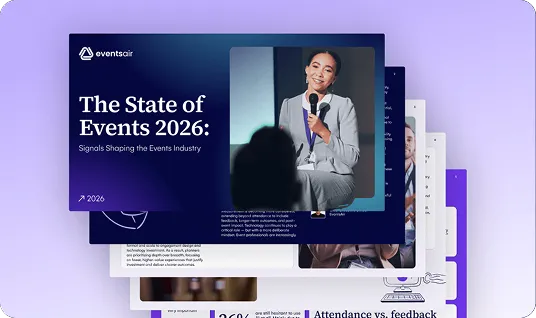
The State of Events 2026 report brings together insights from 380+ event planning professionals worldwide.


Ready to transform event chaos into clarity?
With EventsAir, you’ll move from chasing logistics to creating unforgettable moments. Plan faster, act with confidence, and deliver exceptional events. Discover what’s possible with a personalized demo today.