AI Event Assistants: How Conversational AI Works at Live Events
Every live event has the same pressure points. Sessions, sponsors, schedules, and staff requests all compete for attention simultaneously. The result? An overwhelmed team and a frustrating attendee experience. If this sounds familiar, an AI…


Every live event has the same pressure points. Sessions, sponsors, schedules, and staff requests all compete for attention simultaneously. The result? An overwhelmed team and a frustrating attendee experience.
If this sounds familiar, an AI event assistant is just what you need. It provides instant support, personalized guidance, and real-time information, helping improve attendee experiences while reducing pressure on staff.
In this EventsAir guide, we’ll explain how AI event assistants work, where they add the most value, and what to consider before implementing them at your next event.
What is an AI event assistant?
An AI event assistant is a software tool that lets attendees ask questions and get instant, contextually relevant responses. These interactions can happen through a mobile app, event website, or even a generic messaging platform.
Earlier event chatbots were largely rule-based. They relied on predefined conversation flows, meaning attendees had to select menu options or phrase questions in a specific way to receive the right answer. So, if a request fell outside those programmed paths, the chatbot often couldn’t help.
Conversational AI works differently. It uses Natural Language Processing (NLP) to understand messages beyond the exact words typed. An attendee can ask “What’s happening after lunch in the healthcare track?” and get a useful, specific answer, even if no one pre-programmed that exact phrasing.
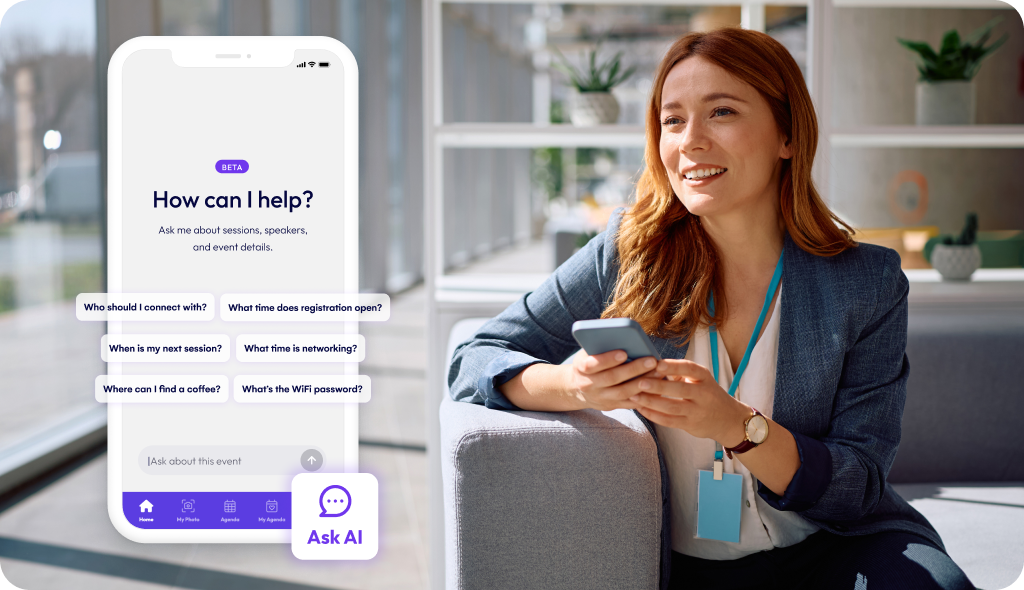
The best event platforms embed conversational AI directly into the event experience. For example, EventsAir’s Air Intelligence Attendee Assistant is built directly into the event app, allowing attendees to ask questions, receive real-time updates, and navigate the event using live event data rather than static FAQs.
Benefits of using conversational AI at live events
When implemented well, conversational AI significantly simplifies the event planning process. Here’s a breakdown of the benefits planners see when they use AI event assistants at live events:
1. Reduced support workload
According to Microsoft’s WorkLab, teams spend a significant amount of time searching for information needed to do their jobs, including event support teams. Conversational AI helps reduce that burden by making information easier to access through natural-language conversations rather than manual search.
At a live event, that means your team spends less time providing answers to repetitive questions and more time handling complex, high-touch attendee needs. This also helps reduce bottlenecks at help desks, especially during peak periods like registration and session changes.
2. Better attendee engagement
Rather than expecting attendees to search through lengthy agendas or exhibitor directories, conversational AI assistants proactively surface personalized recommendations based on attendee interests and behavior. They can recommend relevant sessions, highlight exhibitors and sponsors of interest, and help attendees quickly find the information they need. By making the event easier to navigate, attendees are more likely to discover valuable content and opportunities they may have otherwise missed.
EventsAir’s Attendee Assistant, for example, personalizes recommendations using each attendee’s profile. This means that session recommendations, sponsor discovery, and real-time event guidance are completely aligned with the attendee, helping them get more value from every stage of the event.
3. Improved time efficiency
AI assistants absorb a significant chunk of the repetitive operational load without adding headcount. Research shows that they can reduce issue resolution time by about 50% compared to human agents, and the efficiency gains compound with time.
So if you’re managing multiple events, you can redeploy the saved time toward higher-value tasks like improving attendee experience, coordinating logistics, or supporting sponsors across multiple events.
4. Better sponsor visibility
Sponsors often struggle to stand out in busy exhibitor halls, especially at larger events. Conversational AI helps by making sponsor discovery part of the attendee journey rather than leaving it to chance.
When attendees ask questions about products, services, or topics they’re interested in, AI can recommend relevant exhibitors and sponsors as part of its response. This helps attendees discover organizations that match their interests while giving sponsors more opportunities to connect with qualified prospects.
5. Data-driven event insights
According to the 2026 State of Events Report, audience engagement is the second most important measure of event success, cited by 73.8% of event professionals. Understanding how attendees engage throughout an event is key to delivering even better experiences in the future.
Conversational AI assistants provide valuable insights into attendee behavior by revealing the questions attendees ask, the sessions and exhibitors they explore, and the information they search for most often. Combined with event app analytics, this gives organizers a richer understanding of how attendees interact with the event, helping identify what’s working, where friction exists, and where opportunities for improvement remain.
These insights can be used to refine future events, optimize content, improve attendee journeys, and create more personalized experiences over time.
How conversational AI works for live events
Conversational AI acts as an intelligent layer between your event data and your attendees. It takes information from multiple event systems, processes attendee requests in real time, and delivers personalized responses through various channels.
Below, we will go into detail about how conversational AI works for live events so you can get a fuller picture:
1. Data input
Before an AI assistant can answer questions or make recommendations, it needs access to event information. This data typically comes from several sources, including:
- Registration data: Names, event ticketing information, attendee interests, and preferences.
- Event schedules, speakers, and sessions: Agenda details, session descriptions, room locations, and speaker information.
- Exhibitor and sponsor information: Company profiles, booth locations, products, and services.
- Attendee profiles: Historical event activity, saved sessions, networking interests, and engagement data.
The more complete and accurate this information is, the more helpful the AI assistant becomes. Because EventsAir serves as a single source of truth for your event data, our Attendee Assistant always has access to the latest information – including agendas, speakers, exhibitors, sponsors, attendee profiles, and event updates.
2. AI processing
Once the data is connected, the AI can begin interpreting attendee requests and matching them with relevant information.
Using Natural Language Processing (NLP), the assistant can understand conversational questions such as “Which cybersecurity sessions start after lunch?” or “Where can I find exhibitors focused on healthcare technology?”
It then uses intent recognition to determine what the attendee is trying to achieve, whether that’s finding a session, locating a room, or identifying networking opportunities. Finally, personalization models analyze attendee profiles, interests, and behavior to tailor responses and recommendations to each individual.
3. Response creation and real-time outputs
After processing a request, the AI generates a response almost instantly. These responses may include answers to common questions, personalized recommendations for sessions, exhibitors, event sponsors, or networking opportunities, and event updates and reminders based on an attendee’s schedule and interests.
4. Continuously improving the attendee experience
Every question attendees ask provides organizers with valuable insight into the information attendees need most. If common questions begin to emerge, organizers can quickly identify gaps in event content, update information within the platform, and ensure attendees receive accurate answers moving forward.
Combined with EventsAir’s centralized event data, this creates an AI assistant that becomes more useful throughout the event, not because the AI is learning on its own, but because organizers can continuously refine the information it draws from.
Key use cases of AI event assistants at live events
AI event assistants and AI-powered tools, like EventsAir, are being used at conferences, trade shows, and corporate events to help attendees find information and engage more effectively. Here are some of the most common applications:
1. Attendee Q&A and support
AI event assistants can answer attendee questions instantly, reducing reliance on information desks and support staff. This offers the most immediate return, as it helps eliminate repetitive queries that typically slow down operations during peak event periods.
In fact, AA&P Events & PR uses EventsAir’s AI-powered platform to manage complex, multi-stakeholder events across Australia and the UK. With event information centralized in one system, attendees are able to access schedules, updates, and logistical details more easily during live events.
2. Agenda navigation and scheduling
Large events often feature hundreds of sessions spread across multiple tracks. AI assistants help attendees find relevant sessions, build personalized agendas, and receive schedule reminders throughout the event.
At large-scale healthcare events managed by WiredIn, EventsAir is used to centralize agendas, speaker information, and attendee data across thousands of delegates. This is the type of connected event data foundation an AI assistant needs to recommend relevant sessions and help attendees build personalized schedules based on their interests and event activity.
3. Networking recommendations
Finding the right people is often one of the biggest challenges at large networking events. AI assistants can recommend attendees, speakers, or exhibitors with shared interests, helping create more meaningful networking opportunities.
MCI Canada used EventsAir to facilitate networking between attendees and speakers, helping create meaningful connections at scale. As conversational AI capabilities continue to evolve, AI assistants can further support these experiences by helping attendees discover relevant networking opportunities, sessions, and exhibitors based on their interests.
4. Sponsor and exhibitor discovery
AI event assistants can also help attendees discover relevant sponsors and exhibitors more easily. Instead of manually searching exhibitor directories, attendees receive recommendations based on their interests, event activity, and the sessions they attend.
For example, Impact Events uses EventsAir to integrate registration, attendee profiles, and event operations into a single platform. This allows the AI event assistants to surface more relevant exhibitors and sponsors, helping attendees find the solutions they’re looking for while giving sponsors greater visibility throughout the event.
5. Live engagement tracking and interaction support
During live events, attendees often have questions about sessions, room locations, schedules, or speakers. Rather than waiting in line at the help desk or searching through the event app, they can ask the AI assistant and receive an immediate answer. This helps attendees stay engaged with the event while reducing repetitive questions for event staff.
Factors to consider before implementing AI event assistants
Before deploying an AI event assistant at your event, you need to consider the following factors:
- Data readiness and quality: AI assistants depend on accurate, comprehensive information to operate. So, before going into implementation, you must ensure your details, like registration data, event check-in information, schedules, and exhibitor listings, are complete, up-to-date, and consistent.
- Integration with event platforms and CRMs: To provide real-time answers and personalized recommendations, the assistant should be connected to your event management platform, CRM, registration system, and other key event technologies.
- Training on event-specific content: Conversational AI doesn’t automatically understand your event. It needs to be trained on your agendas, FAQs, venue maps, sponsor information, and event policies to deliver accurate responses.
- Privacy and compliance: AI assistants often process attendee information and behavioral data. Make sure your implementation aligns with relevant privacy regulations and clearly communicates how attendee data will be used.
- Multilingual support: If you’re hosting an international live event, multilingual capabilities can improve accessibility. An AI assistant with multilingual support allows attendees to interact in their preferred language.
Taking these factors into consideration will help you choose a tool that caters to your needs.
What’s next for conversational AI at events?
Conversational AI continues to evolve, creating new opportunities for event organizers to deliver more personalized, connected, and data-driven event experiences.
1. More personalized attendee experiences
As conversational AI continues to evolve, attendees can expect more personalized recommendations based on their interests, attendee profiles, and event activity. Rather than simply answering questions, AI assistants will help attendees discover relevant sessions, exhibitors, sponsors, and networking opportunities, making it easier to get the most value from an event.
2. Deeper integration with event management platforms
The effectiveness of conversational AI depends on the quality of the information it can access. As AI becomes more deeply integrated with event management platforms, it will have access to richer, real-time event data – from agendas and speaker updates to exhibitor information and attendee profiles.
This will enable AI assistants to deliver more accurate answers and recommendations while ensuring attendees always have access to the latest event information.
3. Smarter insights for event organizers
Conversational AI can provide organizers with a deeper understanding of attendee needs by revealing the questions people ask, the information they search for, and the content they engage with most. These insights help identify opportunities to improve event communications, refine future programs, and create even better attendee experiences over time.
How EventsAir uses AI to power smarter events
The value of a conversational AI assistant depends on more than the AI itself. To deliver accurate answers, personalized recommendations, and meaningful insights, it needs access to the event data organizers already manage every day.
That’s why EventsAir’s AI capabilities are built directly into the platform with Air Intelligence. Instead of relying on disconnected systems or manually uploaded information, the AI Assistants have access to your agenda, speakers, exhibitors, sponsors, attendee profiles, and event communications – all from a single source of truth. As event information changes, the Assistants always work from the latest data, helping attendees receive accurate answers and relevant recommendations throughout the event.
Beyond supporting attendees, EventsAir also helps organizers work more efficiently with AI-powered tools that streamline content creation, improve event communications, and provide deeper insights into attendee engagement.
Here are some of the capabilities that set EventsAir apart:
- AI-powered attendee support: Answer attendee questions instantly using real-time event information, reducing repetitive inquiries while helping attendees quickly find sessions, speakers, exhibitors, sponsors, and other important event details.
- Personalized event guidance: Recommend relevant sessions, exhibitors, sponsors, and networking opportunities based on attendee profiles and interests, helping attendees discover more of what your event has to offer.
- AI-assisted content creation: Create emails, session descriptions, announcements, and other event content faster with built-in AI writing tools, helping event teams save time on repetitive tasks.
- Connected event intelligence: Because your event data is managed within a single platform, the AI assistant always works from the latest agenda updates, speaker information, exhibitor details, attendee profiles, and event communications—ensuring accurate, up-to-date responses throughout the event.
- Actionable event insights: Understand the questions attendees ask, the information they search for, and the content they engage with most. These insights can help improve event communications, identify information gaps, and inform planning for future events.
Take your events to the next level with AI
AI event assistants are quickly becoming a core part of modern event delivery. However, as this technology advances, the ability to deliver instant, relevant, and personalized interactions will increasingly define the success of your events.
With EventsAir, you can bring these capabilities together in one place, engaging your attendees more effectively, supporting your team, and delivering events that feel seamless from start to finish.
So, if you’re ready to enhance your attendee engagement and deliver smarter event experiences with EventsAir’s Air Intelligence tools, you’re in the right place. Book a demo today, and we’ll show you how conversational AI can fit into your event lifecycle.

Attendee Experience | Event Technology & Apps
See EventsAir in action
Discover why 12,000+ event professionals trust EventsAir to deliver effortless events, every time.