

How to Write a Press Release for an Event: What to Include and a Step-by-Step Guide


Your event has everything going for it.
On paper, it should be an easy story for the media to cover.
But when you send out the press release, you get an unexpected silence. Why does that happen? The reason can be the way you’re writing your press releases.
You have to communicate your event’s value in a format journalists recognize and respect. And that requires proper knowledge of event press release writing.
In this EventsAir guide, you’ll learn how to write a press release for an event that actually turns heads. We’ll cover each step in detail to make sure you get a real shot at earning media attention.
What sections are included in an event press release?
Before moving forward and rolling up your sleeves to write a press release, you must know what goes into writing one. Here are the key sections of an event press release.
1. Headline
This headline gives the reader a brief sense of what the press release is about. The headline must mention the company’s name and the event.
Here are some headline examples from real brands:
- PCMA's Convening Leaders 2026 Marks a Defining Moment for the Global Business Events Community
- First Look At Imex Frankfurt Education Program: Designed For Today’s Realities And Tomorrow’s Opportunities
Notice how both headlines use the present tense. That's standard practice in press releases. It makes the announcement feel current and newsworthy, even if the event is weeks away.
2. The lead or sub-headline
The lead acts as a subheading that further entices the reader. This comes right after the Headline and before the press release intro paragraph.
Read the sub-headline right after the headline in this PCMA event press release:
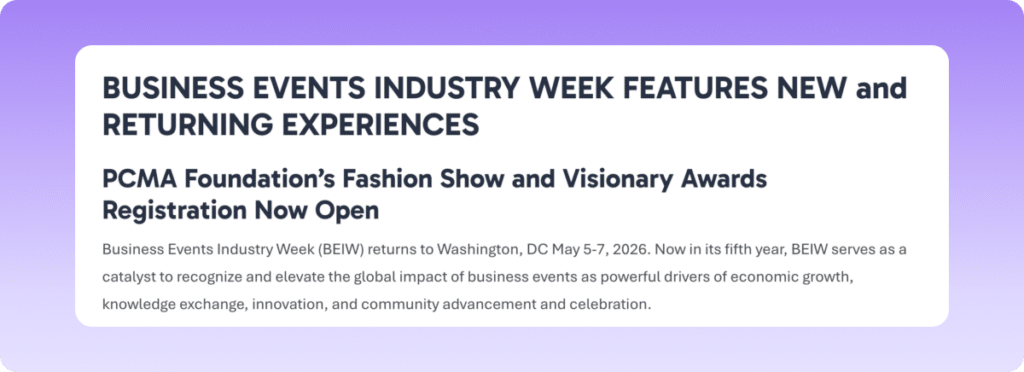
This sub-headline works because it expands on the headline with specific details the reader couldn't get from the title alone, like the event’s place, event date, etc. It gives readers enough new information to stay interested without repeating what the headline already said.
3. Intro paragraph
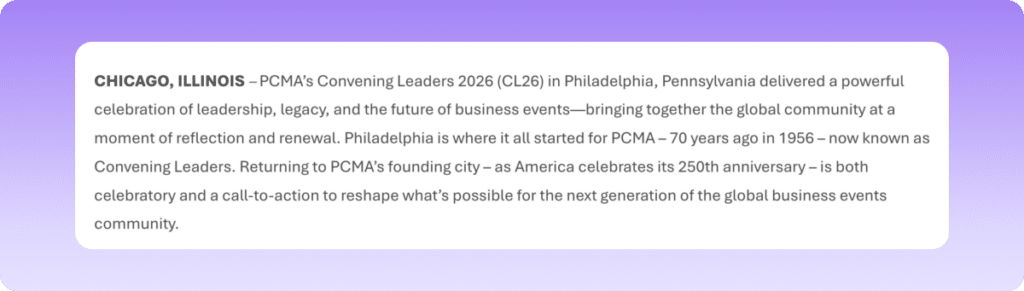
In this paragraph, you get to the point without any teasing. You have to be direct and express what the press release is about. You should not treat it as a blog.
It is standard for this paragraph to start with the location and date.
Here’s the intro paragraph from the PCMA event press release:
4. Body
Without making any heading, you’ll move on to the next paragraphs of the press release, known as the body of the article.
The body adds more context to substantiate a press release’s message. Because there’s no guarantee journalists will read to the end, details in this section are written in a reverse pyramid format.
That means the most important information goes at the very top, followed by supporting details and background context in descending order of importance.
You have the freedom to use bulleted list(s) or tables where suitable. But make sure you use them appropriately and avoid overuse.
5. Boilerplate
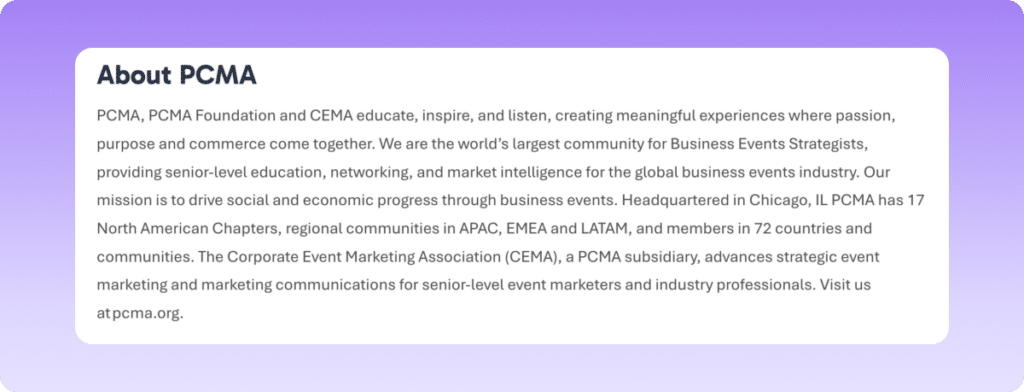
Found at the end of the document, the boilerplate works as a short “About us” for the company hosting the event. It often shows the company’s history, the brand's identity, the mission statement, and contact details.
Here’s how PCMA writes its boilerplates:
Now, let’s teach you how to write a press release for an event step-by-step.
How to write a press release for an event in 10 easy steps
Step 1. Gather all essential event details
This is obvious, and you might already have all the information in place, but you still need to be reminded about this step, especially if you’re running behind your event planning timeline.
Before you draft a press release, gather all relevant information about your event. The basics are date, time, and location. But you also need to note down things like:
- If registration is required
- Whether there’s a cost to attend
- If there are any access restrictions
- If it’s open to the public or industry-only
- Whether attendees can bring guests
Journalists look for these details in a press release, among other things. So make sure you don’t miss opportunities by leaving them out. Also, remember to verify the information. You don’t want your press releases to go out with incorrect speaker information or last year’s dates.
Speaking of speakers, make sure you confirm their credentials (name, job title, company, etc.). And, if you're featuring multiple speakers, note their session topics and timings as well. We usually recommend you stick to your keynote or any one of particular industry relevance and notoriety.
If you're managing an in-person event, keeping an on-site event planning checklist handy can help you track these details alongside your other logistics.
Step 2. Research similar event press releases in your industry
Avoid writing a press release about an event in a vacuum. Before putting pen to paper, spend time looking at how others in your industry handle press releases. Make a list of top companies similar to yours and search for their event press releases. It’s better if those events share characteristics with the type of event you’re planning.
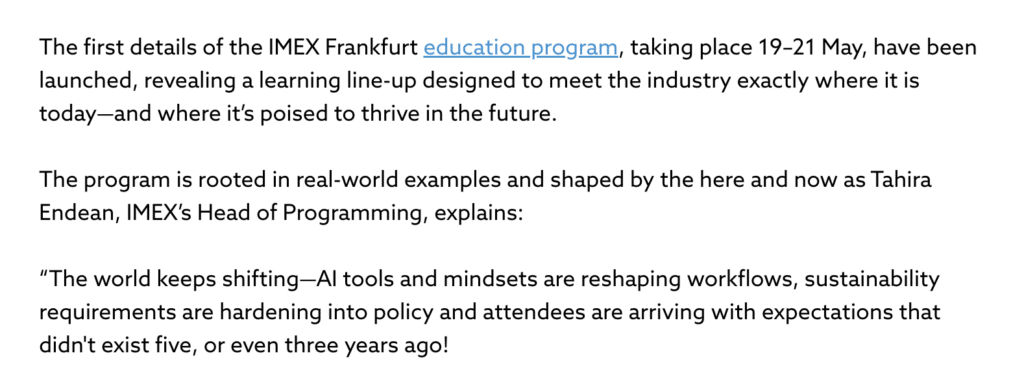
For example, if you’re organizing an education or a corporate event, you may look at how IMEX announces its education program.
Industry publications often archive their press releases. Alternatively, you can visit sites like PR Newswire and browse their searchable databases of press releases.
Now, what to look for in those event press releases? Patterns like:
- Structure and tone
- How do they open?
- What details do they emphasize?
- How much space do they give to speakers vs logistics?
- How many paragraphs do they dedicate to registration details vs the event's broader significance?
This research phase will save you from reinventing the wheel and help you avoid common mistakes in writing event press releases.
Step 3. Write an attention-grabbing headline
Your headline has one job: to make people click. And for that, it has to be clickbaity (not in a negative sense).
Compare these two headline examples:
- "Company X Announces Annual Conference"
- "Industry Leaders to Tackle AI Ethics Crisis at Global Tech Summit 2026."
Which of the two will a journalist click, given he has to see hundreds of press releases each day?
The second one, right? Because the first one tells almost nothing. The second one gives you the who, what, when, plus a hook that signals actual news.
So how do you write headlines like that? Here are a few tips for your ease:
- Include your full event name if it’s recognizable or if people need to know it for context. For example, if you’re announcing the fifth iteration of an annual event, the word “fifth” is also worth including.
- If you have newsworthy numbers that can make your audience believe your event is a big deal, use them. Look at these examples:
- "500+ Association Executives to Gather for ASAE's Annual Leadership Conference in Boston"
- "First-Ever Pan-African Higher Education Forum Brings Together 200+ University Leaders"
- Don't oversell with words like "revolutionary," "groundbreaking," "world-changing," etc., if you cannot back them. And realistically speaking, you cannot back these words. They are hyperbole, and journalists have seen them all before.
- Keep the headline under 100 characters if you can. Writing longer content may cut off the ending in search results or elsewhere. If you can cut a word or a phrase without losing the catchiness or meaning, cut it.
Step 4. Write a sub-headline that provides additional context
The sub-headline expands on your headline with just enough additional information. It shouldn’t give everything away. In this section, you can add what you couldn’t in the headline.
For instance, if your headline didn’t have room to mention a celebrity keynote speaker or the fact that you're partnering with a major organization for the first time, that can go in the sub-headline.
Length-wise, your headlines will be either one long sentence or two short sentences. In total, they should occupy two lines. A little over two lines can also work, though.
Step 5. Structure your intro paragraph with the 5 W's
After the headline and subheadline, your press release’s body begins. The intro paragraph holds a lot of weight here. It needs to answer five basic questions right out of the gate:
- Who is organizing this event?
- What is the event about?
- When is it happening?
- Where will it take place?
- Why should the audience care?
You might think that’s a lot of information for a single paragraph. But it isn’t. You just need to know how to fit it all in a few words. For example, look at the following intro paragraph of a hypothetical event’s press release:
“BOSTON, March 10, 2026 — GreenTech Alliance will host the North American Sustainability Summit on April 22-24 at the Boston Convention Center. The convention will bring together 500+ industry leaders, policymakers, and innovators to address the urgent challenge of corporate carbon neutrality. The three-day conference will feature keynote addresses from climate scientists and the unveiling of new industry-wide emissions standards.”
Notice how the paragraph has woven together answers to all five Ws to tell a story. It doesn’t feel like a checklist of answers to five questions.
The location and date at the very beginning are standard practice. The Location can be your base city, and the date is the press release’s launch date, not the event’s.
Step 6. Elaborate with body paragraphs
After your headline, sub-headline, and the intro paragraph have painted the broader picture, the body paragraphs provide the supporting details. There should be only a few of these paragraphs before you wrap up the press release. And each subsequent paragraph should feel slightly less urgent than the one before it.
You can talk about the full agenda or session breakdown in these paragraphs, particularly if you have notable speakers or unique programming. If there's a registration process, spots are limited, or there’s a way to attend virtually, it should be detailed in the body paragraphs.
You might also dedicate a paragraph to partnerships or sponsors if they add credibility. Mentioning that you're collaborating with a respected university or backed by a major industry organization signals legitimacy. But only include this if it genuinely strengthens the story, because a list of unknown sponsors might not be particularly helpful.
Step 7. Include quotes
You can also include one or two quotes to add personality and opinion to your press release. Here’s a quote example from the IMEX announcement of the education program, an example we discussed earlier:
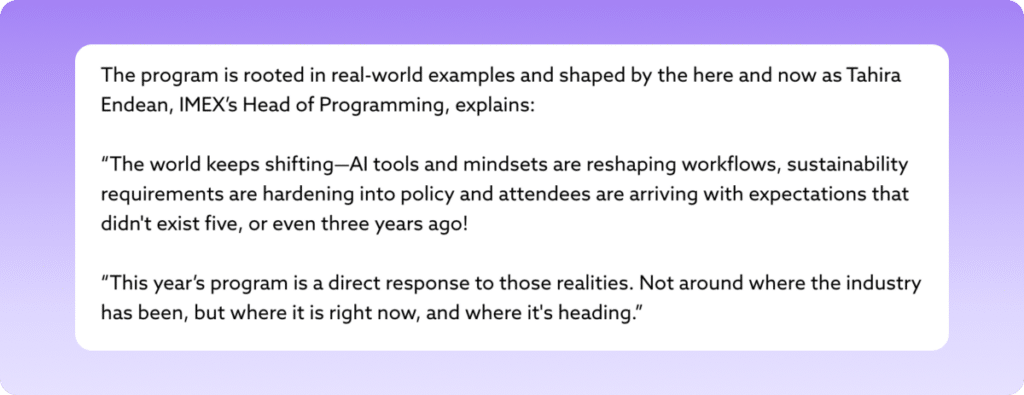
The biggest mistake people make with quotes is treating them like filler.
You might’ve read releases that say something like "We're excited to announce this event" or "We look forward to welcoming attendees." These quotes don’t add much value, and journalists don’t like too much fluff.
So what makes a quote actually useful? It should do these three things.
- Explain why this event matters to the broader audience, not just to your company.
- Provide an insider perspective or context that wouldn't make sense in the press release's narrator voice.
- Add emotional weight to the announcement in a way that feels human and genuine.
Here's an example of a weak quote vs a strong one for our hypothetical sustainability summit:
- Weak: "We're thrilled to host the North American Sustainability Summit and can't wait to see everyone there."
- Strong: "Corporate sustainability commitments are hitting a wall because companies lack practical implementation frameworks. This summit exists to change that by connecting the people writing the checks with the engineers and scientists who can actually deliver results."
There are two ways to get quotes. You can either draft the quote yourself on behalf of a speaker and have them approve it. Or you can simply ask them to write it. You can then edit and optimize the press release.
Ideally, the speaker of the quote should be someone with authority or a direct connection to the event. That could be your CEO, the event director, a prominent speaker, or even a past attendee if their perspective adds credibility.
Step 8. Add multimedia elements
It’s best for your press release to have visuals, as that gives journalists rich content for their audiences. The visuals can be high-quality video, audio, images, or infographics.
Here's a simple table showing what multimedia works best for different event types:
| # | Event type | Best multimedia options |
| 1 | Conference/summit | Speaker and venue photos, agenda graphics |
| 2 | Product launch event | Product images, demo videos, event space renders |
| 3 | Charity fundraiser | Past event photos, beneficiary stories, and impact graphics |
| 4 | Workshop/training | Instructor credentials, venue setup, and sample materials |
| 5 | Festival/public event | Venue aerials, performer photos, crowd scenes from past years |
Don't forget alternative text for images if you're distributing the press release digitally. It helps with accessibility and search engine optimization. Just a brief description of what's in the image is enough.
Step 9. Include registration or RSVP instructions
Near the end of the press release, before the boilerplate, add a direct call to action (CTA) that tells people what you want them to do.
For example, say "Register for the summit at www.youreventsite.com" rather than "More information can be found on our website." The first version sends people directly to your registration page with a clear goal in mind. The second makes them hunt for the action.
Here's what solid registration instructions might look like:
Registration for the North American Sustainability Summit is now open at www.sustainabilitysummit2026.com. General admission tickets are $499 through March 15, after which the price increases to $649. Media representatives can request complimentary press passes by emailing [email protected] with their credentials. Space is limited to 500 attendees.
One more thing. If your event is free, say so explicitly. Don't make people click through to find out there's no cost. Free events have their own appeal, and you should lead with that.
Step 10. Write a boilerplate and add contact details
The boilerplate is your company's standard introduction that appears in every press release you send, and is usually titled “About [Company Name]”.
You can include a few sentences about what your organization does and how long you've been around, if that's relevant, among other details that establish authority.
It’s best to choose 2-3 things about your company that represent it well. Don’t try to cram everything in.
Here’s how ASAE (American Society of Association Executives) puts a boilerplate in one of its press releases:
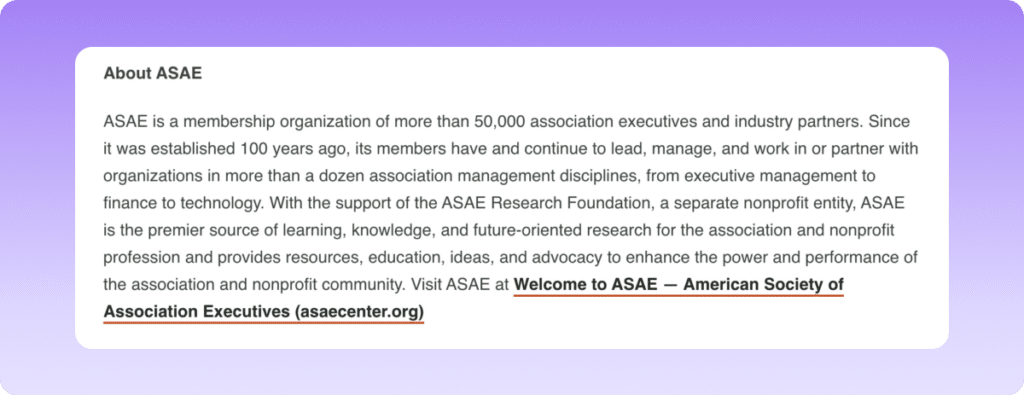
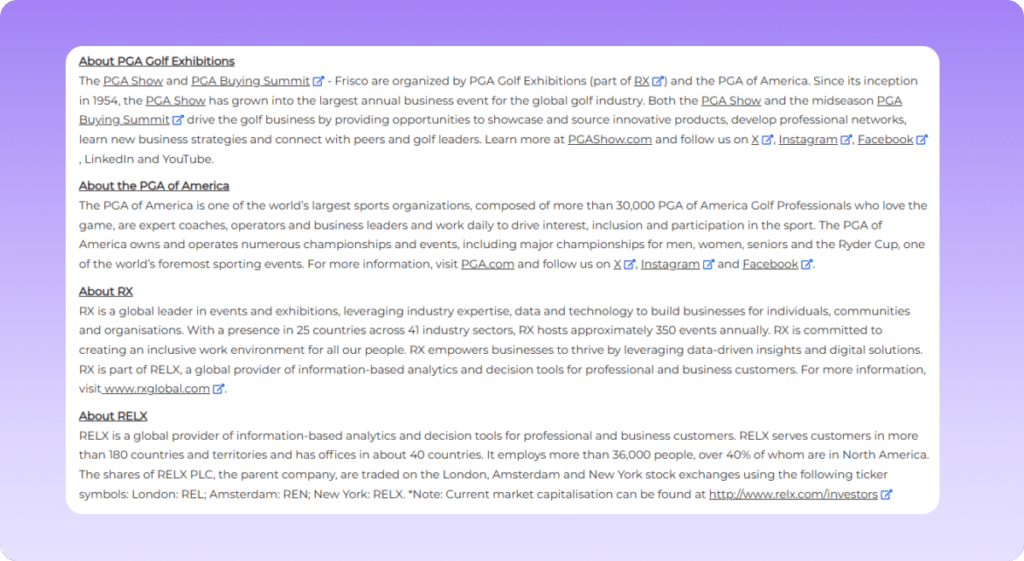
If your event is being hosted by more than one organization, you'll need separate boilerplates for each collaborating party.
For instance, the two boilerplates in this press release of a PGA event:
After the boilerplate, add your media contact information. This should include a name, title, phone number, and email address for whoever is handling press inquiries. Make sure this person is actually available and prepared to respond quickly.
Here’s a sample format for pasting contact details:
Media Contact:
Sarah Chen
Director of Communications, GreenTech Alliance
(617) 555-0123
sarah.chen@emailaddress.com
Plan your next event press release with EventsAir
A strong event press release comes down to a clear headline, a structured body that follows the reverse pyramid, and a quote that adds real weight. Once the writing is done, the next challenge is getting it in front of the right people at the right time. And that's exactly where EventsAir comes in.
EventsAir provides a centralized communication platform for sending targeted messages to attendees, exhibitors, speakers, vendors, and media contacts.
You write your press release, schedule follow-up emails, send personalized invitations, and track who's engaging with your content without ever leaving the platform. The platform includes features for managing submissions, coordinating reviews, building program schedules, and communicating directly with presenters.
When details change or new announcements emerge, you can instantly update stakeholders. Plan your next event press release inside EventsAir's all-in-one communication suite!
See EventsAir in action
Discover why 12,000+ event professionals trust EventsAir to deliver effortless events, every time.




Ready to transform event chaos into clarity?
With EventsAir, you’ll move from chasing logistics to creating unforgettable moments. Plan faster, act with confidence, and deliver exceptional events. Discover what’s possible with a personalized demo today.