5 Event industry trends and insights to watch in 2024
What will 2024 look like for the global events industry? No one really knows the answer to that question for sure… but we can venture some educated guesses based on the current trends and insights…


What will 2024 look like for the global events industry? No one really knows the answer to that question for sure… but we can venture some educated guesses based on the current trends and insights we’ve observed over the past 12 months.
Today we’ll take a look at the five event trends we believe will shape our industry over the next 12 months. From understanding the role of technology, to getting real about hybrid, to welcoming a younger demographic, and more – there are boundless opportunities on offer, as well as a lot of work to be done. So let’s roll up our sleeves and jump in.
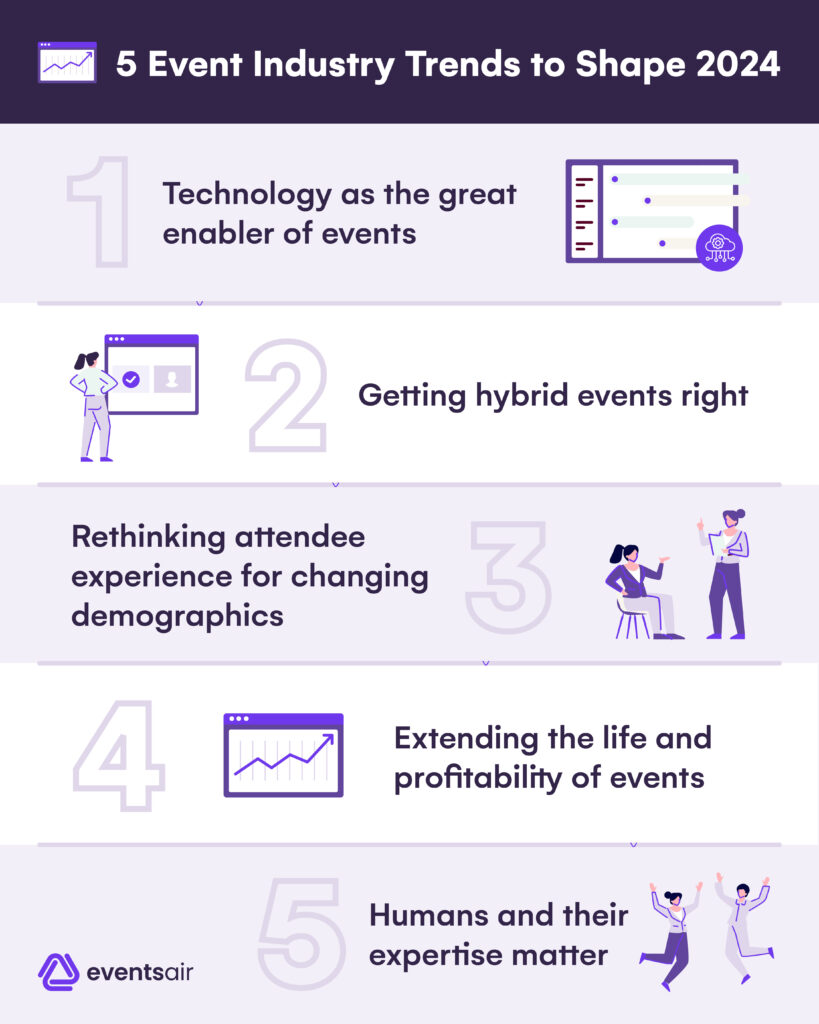
Event industry trend 1: Technology as the great enabler of events
Technology has progressively become a key ingredient in most events, however, it really became event tech’s time to shine in the early pandemic period. With in-person event opportunities limited at best, virtual delivery platforms became the sole enabler of events – and we were ready to forgive some hiccups in the delivery and audience experience while we got things right.
Fast forward to 2024, and we still see technology as the “great enabler” of the events industry – although the context has significantly evolved from the lockdown era (we also can’t believe it has been four years). Whereas during COVID it was simply the only way you could run an event, now it’s about efficiencies and doing more with less. From managing budgetary challenges caused by rising inflation and cost-of-living factors; to helping professional event planners deal with talent shortages; to delivering events with minimum wastage or hiccups – technology continues to play a leading role in helping the events industry run more events well, with limited resources.
Event industry trend 2: Getting hybrid events right
Earlier I mentioned that audiences were ready to forgive some hiccups in the early days of virtual and hybrid events. We would argue that the window of forgiveness is coming to a rapid close, if it hasn’t already.
In 2023, we were talking about how it’s time to move on from the hybrid v virtual v live debate – and that good events just are, regardless of their format. This still holds true, and 2024 is the year when the rubber hits the road.
It’s time for the industry to get hybrid right – making it simple, repeatable and cost-effective. Many of our customers are avoiding hybrid events for this reason, but we still see a real need for being able to join events remotely, or at least consume the content. We think a large part of that is going to be finding new ways to reuse and monetize event content (more on that a bit later…), but without skimping on the networking opportunities that are so important for most events. Overall, it’s going to be about meeting the divergent needs of both in-person and virtual attendees – and that’s a hard balance to get right, but we believe it can be done.
We’ll be experimenting with hybrid formats throughout 2024 and are looking forward to sharing what we find with you.
Event industry trend 3: Rethinking attendee experience for changing demographics
Whether you are a Gen Z and are classed a digital native, or a bit older (be nice) and are less of a tech geek, there is no doubt that the proliferation of good technology, mobile devices and apps has shaped the broader population’s expectation. For events we are talking table stakes… as one of our customers put it to me; ”the pies must be hot and the event app just needs to bloody well work”.
While the experience of your key audiences will always have unique requirements, some overall trends are shaping how events will be delivered in 2024 and beyond (and therefore, how we’re currently developing our technology to support event delivery).
At the top of the list is creating seamless, continuous journeys across your event life cycle, which match what people have come to expect in other areas of their life. Another consideration is how audiences are consuming information. We know that people are increasingly fatigued by all-day events, with more and more of us accustomed to short-form media snippets and “quick hits” of engagement (thanks, TikTok and Instagram).
So, how should we get these matches right? Are we talking about Tinder for events? Not quite, but it’s an interesting idea. Stay tuned for more…
Event industry trend 4: Extending the life and profitability of events
Events generally require considerable investment (whether this be time, or money, or mountains of both) – which more than pays off when they’re done right. Given the budgetary constraints many businesses are facing in 2024, it’s never been more important that we get as much value as possible from each and every event. It’s often the case that we put all this effort into an event and as soon as it has finished we celebrate a good job with the team at the bar, and then we are straight onto the next one.
As we start to think about the event experience as being more of an ongoing journey, with continuous engagement, there are going to be opportunities to monetize different aspects of the journey. Events are an exceptional content engine, so the obvious example is making your content available on-demand, after the event – whether this be free or behind a paywall.
We think content reuse is just the beginning when it comes to extending the life and profitability of your events. We’ll share some use cases in the next few months.
Event industry trend 5: Human connection matters, a lot
To round things out, we refer back to point one: technology as the great enabler of events. Note that we’re calling it the “enabler”, rather than the value proposition in itself. Yes I know, fancy that coming from the CEO of an event tech company, but it is true.
It doesn’t matter how great the technology is (and we’re including AI in this discussion). When it comes to events, human connection is what matters most. Yes, content is important – but at the end of the day, the content can be shared in any number of ways. What makes events important (and different) is the human factor. True storytelling, paired with lived experience, can not be replicated or replaced by AI.
Thankfully, we believe that technology will always allow us to facilitate deep, human connections and enhance accessibility for all. Technology can remove barriers – to participation, to language, to location, and so, so much more. The intent should be ‘How can we utilize our tech in different, new, engaging ways?’ rather than ‘How can X technology replace Y?’.
Although simple, a great example is capitalizing on digital signage and doubling-down on personalization. Welcome individual guests, sponsors, exhibitors, and attendees to your event. Could you imagine seeing a sign read ‘Thanks for travelling to AirTime all the way from Perth, Lucy Smith’ (believe me, you can do this right now). People find beauty in the simple things.
How can we help you capture the value of the latest event trends?
At EventsAir, we understand the importance of selecting the right event technology partner – someone who can help you deliver successful, inspiring events both today and in the future. We’ve been innovating in the events industry for more than 30 years, and events are at the core of our DNA.
Thanks to our rich heritage, we also understand what’s next for the events industry. It’s the reason why serious event planners around the world choose our industry-leading event technology platform.
We have one simple mission: to help event planners deliver the WOW in their events with the world’s most powerful event management technology. We’ve delivered some of the world’s biggest events, and we’d love to help you too.
Event Industry Trends | Event Technology & Apps | EventsAir
See EventsAir in action
Discover why 12,000+ event professionals trust EventsAir to deliver effortless events, every time.